


PACKML: Improving Integration and Efficiency in Modern Packaging Lines
In today’s packaging environments, one of the ongoing challenges is getting different machines on a production line to work together seamlessly. From bagging to wrapping and palletising, each piece of equipment has traditionally operated using its own control system, communication protocol and interface. This often leads to complex integrations, slower fault diagnosis, and reduced flexibility when changing products or formats.
PACKML (Packaging Machine Language) was developed to address exactly this challenge. By introducing a standardised communication framework, PACKML enables machines from different manufacturers to operate as a unified system.
In industries such as food and beverage processing, packaging automation and manufacturing, standardised communication between machines is essential for efficient production.
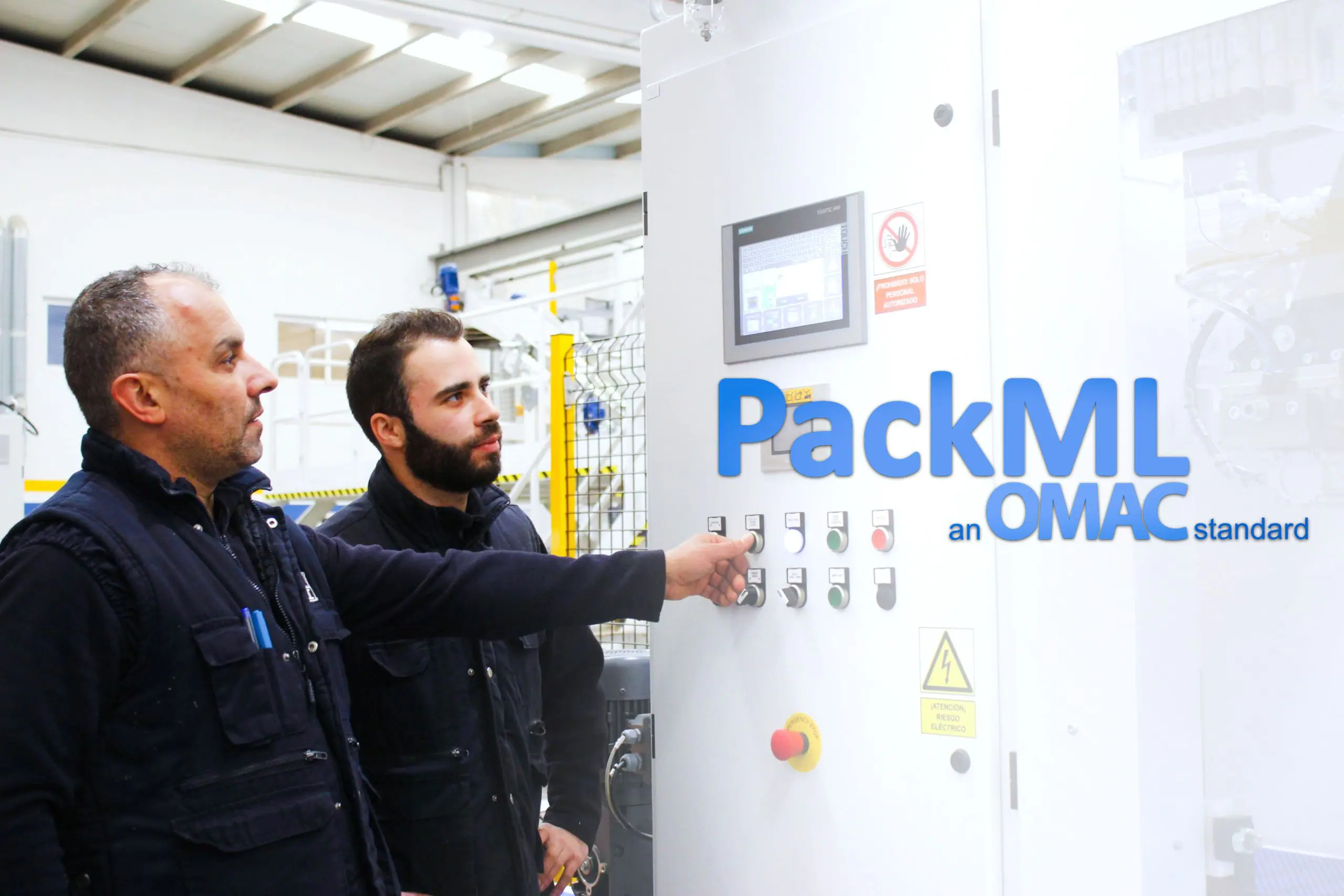
What is PACKML?
PACKML is a globally recognised standard developed by OMAC (Organisation for Machine Automation and Control) and aligned with ISA TR88.00.02. Its purpose is to standardise how machines communicate and operate within a production line.
In practical terms, PACKML introduces:
- Common operating states
All machines follow the same operational states (such as starting, running, stopping), making it easier to monitor and control the line. - Standardised interfaces
Operator screens (HMIs) present information in a consistent way, improving usability and reducing training time. - Uniform data structures
Information is shared using standardised tags (PackTags), simplifying integration with systems such as MES, ERP and SCADA. - Faster commissioning
With a shared “language” across machines, setup and integration become quicker, more predictable, and more cost-effective.
Overall, PACKML improves consistency across operations while reducing downtime and integration complexity.
How PACKML works
PACKML is built around two key concepts: machine states and operating modes.
Machine States
These represent the different stages of a machine’s operation, such as:
- Stopped
- Starting
- Idle
- Execute (running)
- Stopping
- Holding / Held
- Aborting / Aborted
- Completing / Complete
Because all machines follow the same structure, it becomes much easier to understand what is happening across the entire line and respond consistently to issues.
Operating modes
These define how the machine is being used, for example:
- Automatic
- Manual
- Maintenance
Together, these states and modes create a clear and logical framework that improves coordination, simplifies training, and enhances overall efficiency.
PACKML in practice
In a PACKML-enabled packaging line:
- Integration with higher-level systems (MES, ERP, SCADA) is far more straightforward
- Equipment such as bagging, palletising and wrapping machines can communicate without complex custom programming
- New machines can be added with minimal disruption to the existing system
- Maintenance teams can diagnose faults more quickly using standardised alarms and messages
Key benefits for manufacturers
Adopting PACKML delivers several measurable advantages:
- Improved efficiency
Machines operate in sync, reducing stoppages and miscommunication - Greater flexibility
Production lines can adapt more easily to new products or packaging formats - Reduced costs
Less engineering effort is required for integration and upgrades - Simplified training
Operators work with consistent interfaces across all equipment - Better data visibility
Standardised data enables more accurate performance tracking and analysis
PACKML also supports broader Industry 4.0 initiatives, where interoperability and real-time communication are critical.
Considerations and challenges
While PACKML offers clear benefits, adoption is still growing. Some common challenges include:
- The need for ongoing development to align with emerging technologies such as AI and industrial IoT
- Limited awareness or implementation across certain industries
- Older equipment that may require upgrades or adaptation
PACKML vs Traditional Packaging Lines
| Aspect | Traditional Line | PACKML-Enabled Line |
|---|---|---|
| Integration | Complex, machine-specific | Standardised and simplified |
| Maintenance | Inconsistent alarms and diagnostics | Faster, uniform fault finding |
| Flexibility | Difficult to expand or modify | Easy to add new equipment |
| Engineering Costs | High due to customisation | Reduced through standardisation |
| User Experience | Different interfaces per machine | Consistent and intuitive |
TMI’s approach to PACKML
TMI is actively incorporating PACKML into its solutions, including automatic bagging systems, palletising, and end-of-line equipment.
This involves aligning control architectures, HMI design, and data structures, while ensuring close collaboration between engineering, software, and technical teams.
For TMI, adopting PACKML is a strategic step towards delivering more integrated, efficient, and future-ready packaging solutions—designed to meet the demands of a connected, modern manufacturing environment.
Article adapted for USS Pactech
Original author: Oriol Miarnau, Lead Automation Engineer
Source: TMI (tmipal.com)
Bringing global technology to South Africa
As the distributor of TMI equipment in South Africa, USS Pactech ensures local support, technical expertise, and access to OEM-quality solutions for complete bagging and palletizing lines.

Other Articles
Premium vacuum packaging for the food industry in South Africa
USS Pactech installed a fully integrated vacuum packaging system for a meat packaging plant In the landscape of food packaging, ensuring product freshness, extending shelf life and maintaining visual appeal are paramount. Supervac, a leader in vacuum packaging solutions, addresses these challenges with innovative technologies accessible in South Africa through USS Pactech. Comprehensive vacuum packaging […]
A sustainable leap in recyclable spout pouch production
A collaboration between SN Maschinenbau and SÜDPACK introduces an economical and sustainable overall concept for the in-house production of recyclable spout pouches.
Enhancing South African Filling Production with CFT Group and USS Pactech: A Case Study with Edward Snell & Co.
The Edward Snell facility is home to two high-performance CFT Magic Rinser/Filler/Capper Tribloc machines. These machines are critical to the production of their spirits portfolio.