


Flexible dairy packaging for an increasingly diverse market
The modern dairy aisle bears little resemblance to the one consumers encountered a decade ago. Alongside traditional milk, yoghurt and cheese products, shoppers can now choose from multiple flavours, portion sizes, multipacks, dietary formulations and convenience formats.
This variety helps dairy brands appeal to different markets, respond to changing consumer preferences and create new opportunities for growth. On the production floor, however, it presents a significant packaging challenge.
End-of-line systems must be able to accommodate different product sizes, pack counts and secondary packaging formats without sacrificing speed or efficiency. They must also be ready for products and packaging concepts that may not yet exist when the equipment is first installed.
To help South African dairy manufacturers meet these changing requirements, USS Pactech supplies advanced secondary packaging and automation solutions from Cama Group, a globally recognised specialist in packaging machinery and complete packaging lines.
Why flexibility has become essential
Production runs are no longer necessarily built around one product in one format. A dairy manufacturer may need to package several yoghurt flavours, different bottle sizes and a range of retail and bulk configurations on the same line.
According to Cama Group’s dairy specialists, manufacturers are therefore scrutinising packaging equipment more carefully. They are not only considering whether a system can handle today’s product range, but also whether it can be adapted for products planned for the months and years ahead.
This has reduced the appeal of machinery dedicated to a single product or pack format. Modern dairy packaging systems need to handle variations in:
- Product dimensions and container types
- Individual and multipack configurations
- Retail, family and bulk pack sizes
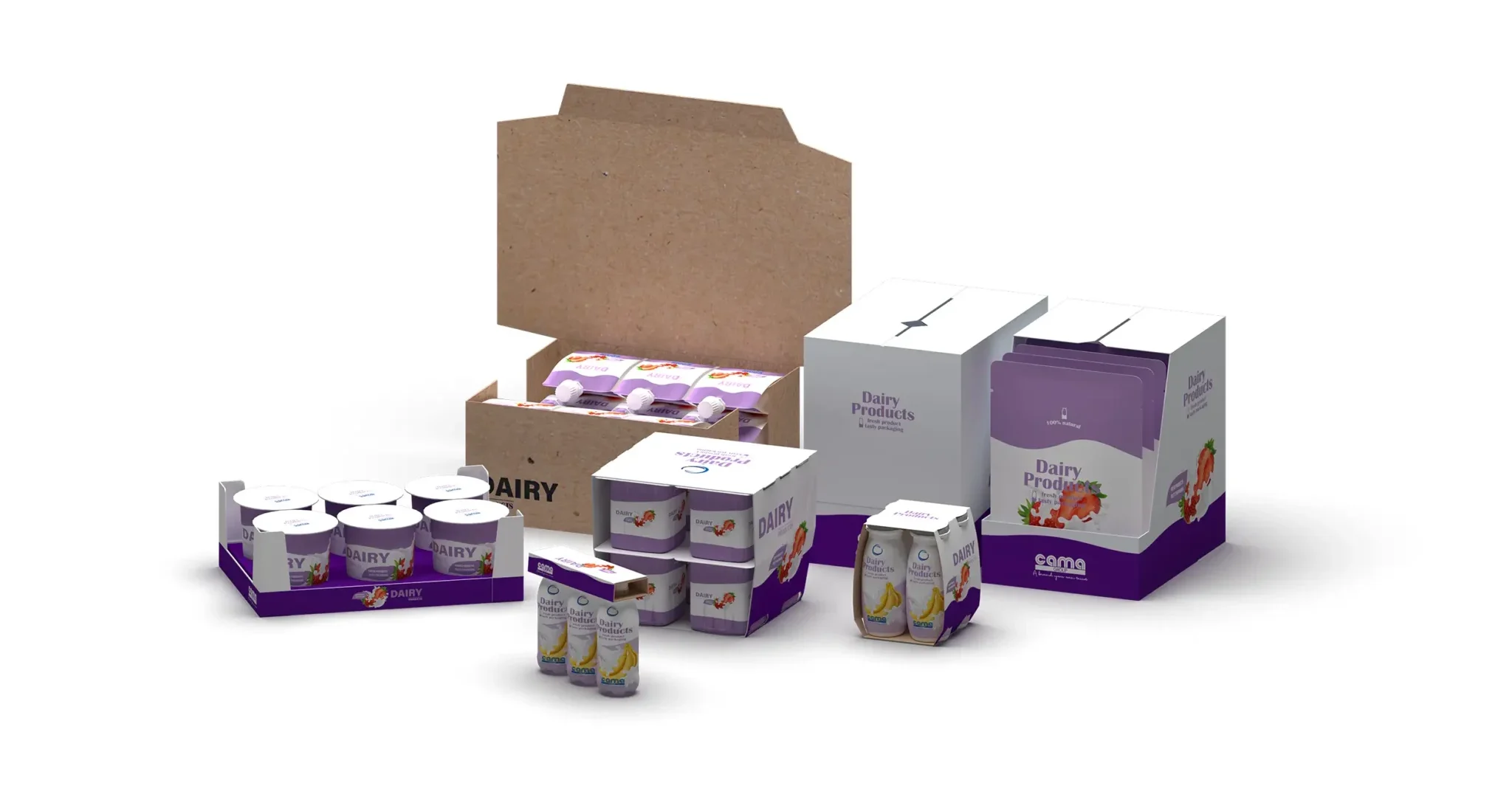
- Cartons, cases, trays and wraparound sleeves
- Production volumes and batch sizes
Equipment flexibility is only part of the equation. Format changes must also be completed quickly. A machine may technically be capable of processing numerous products, but frequent and time-consuming changeovers can still undermine overall line productivity.
Cama develops systems with efficient format-change procedures, accessible machine layouts and automation technologies that help operators move between batches with less downtime.

Achieving more within a limited footprint
Space is another pressing concern for dairy processors. Many established production facilities are located close to major population centres, where additional industrial space is difficult or expensive to obtain.
Rather than expanding the building, manufacturers may need to increase output and product variety within the available production area.
Cama’s compact and monobloc packaging systems are designed to provide high performance while using floor space efficiently. Their modular construction allows a system to be configured around the plant layout rather than forcing the manufacturer to redesign the facility around the machine.
Depending on the application, systems can incorporate:
- Single-side operator access
- Flexible product in-feeds
- Adaptable utility connections
- Modular machine sections
- Configurations that follow corners or restricted production areas
This makes it possible to introduce sophisticated end-of-line automation into facilities where space is at a premium.
Combining production speed with versatility
High-speed production remains essential in the dairy industry. Flexibility cannot come at the expense of throughput, particularly where products must move continuously from filling and primary packaging into secondary packaging.
Cama systems are designed to balance these requirements.
One machine could, for example, place four yoghurt tubs into wraparound sleeves and then load the multipacks into family-size cartons. Following a format change, the same system could use a bypass conveyor to place 48 individual pots into a case. It could subsequently be configured for eight- or sixteen-pot packs.
The manufacturer gains the ability to produce several market-ready configurations without investing in separate packaging equipment for every variation.
This versatility can also make it easier to introduce new products, promotional packs or retailer-specific configurations without extensively reengineering the line.
Technology that simplifies changeovers and operation
As packaging systems become more capable, they must also remain manageable for operators and maintenance teams.
Cama incorporates technologies such as augmented reality, virtual reality and RFID identification into its packaging solutions. These tools can guide operators through changeovers, maintenance procedures and machine configuration.
RFID technology can identify format parts and help confirm that the correct components have been installed for a particular product or production batch. Digital instructions can then lead the operator through the necessary steps.
These capabilities help to:
- Reduce changeover time
- Prevent incorrect format-part installation
- Support consistent operating procedures
- Accelerate operator training
- Reduce reliance on knowledge held by individual employees
- Assist maintenance and fault-finding activities
This last point is becoming increasingly important. As experienced engineers retire, manufacturers risk losing years of accumulated machine and process knowledge. Clear human-machine interfaces and digital assistance tools help retain and transfer that knowledge to the next generation of operators.
Looking beyond the initial equipment price
Capital expenditure will always influence packaging-equipment decisions, but the purchase price alone does not show the full financial picture.
A less expensive machine may ultimately cost more if it produces excessive downtime, requires lengthy changeovers, generates packaging waste or cannot accommodate future product formats.
Manufacturers should therefore consider the system’s total cost of ownership, including:
- Production throughput
- Equipment uptime
- Changeover duration
- Labour requirements
- Energy consumption
- Packaging-material waste
- Maintenance requirements
- Format flexibility
- Future upgrade potential
A flexible and efficient packaging system can improve overall equipment effectiveness while allowing the manufacturer to respond to new market requirements without immediately investing in another line.
A high-speed dairy application in practice
Cama’s capabilities were demonstrated in a project completed for a leading international dairy company producing medicinal dietary drinks.
The application included 125 ml bottles running at nominal speeds of approximately 650 products per minute, with the system capable of accommodating substantially higher rates. It was also designed to process 200 ml and 250 ml bottle formats.
After receiving PET shrink sleeves, the bottles are separated into two lanes and arranged into 24- or 32-product arrays. Products can alternatively be diverted to different modules for the creation of four- or six-bottle clusters.
The integrated line incorporates:
- Automatic product dividing and conveying
- Multipack and case-packing modules
- Print-and-apply labelling
- Collaborative robotic loading of carton blanks
- Shrink-sleeve equipment
- X-ray inspection
- Coding and code-verification technology
By integrating both Cama equipment and selected third-party technologies, the project demonstrates how individual processes can be brought together as a coordinated turnkey packaging solution.
Supporting more sustainable dairy packaging
Sustainability is influencing both dairy packaging design and the machinery used to process it. Manufacturers are under pressure to reduce energy use, limit waste and move towards lighter or more readily recyclable packaging materials.
Cama considers these requirements during both machine and packaging development. Its approach includes reducing equipment energy consumption, limiting material waste and helping manufacturers optimise secondary packaging designs.
The move towards mono-material packaging is particularly relevant. Future dairy packs may increasingly use compatible or similar recyclable materials across tubs, lids and secondary packaging. Machinery must be able to handle these evolving materials without compromising pack quality or line performance.
Packaging design should therefore be considered alongside automation from the beginning of a project. Decisions made about a carton, tray, sleeve or case can affect material use, transport efficiency, machine performance and recyclability.
A complete approach to dairy packaging automation
The most effective dairy packaging solution is not necessarily the fastest individual machine. It is the system that provides the right combination of:
- Flexibility across products and pack formats
- Fast, repeatable changeovers
- Reliable production speeds
- Efficient use of factory space
- Accessible operation and maintenance
- Lower material and energy waste
- Capacity for future products and packaging formats
Cama Group provides individual packaging machines and complete integrated lines for dairy applications, including cartoning, sleeving, wraparound case packing, robotic top loading and automatic carton loading.
As Cama’s equipment representative in South Africa, USS Pactech helps local dairy producers identify and implement solutions suited to their products, production targets and facility requirements. This is supported by local consultation, engineering, project management, installation, training, technical assistance and after-sales service.
To discuss a new dairy packaging line or improvements to an existing end-of-line operation, contact the USS Pactech team.
This article draws on technical insights originally published by Cama Group. Cama packaging equipment is represented in South Africa by USS Pactech.

Other Articles
Premium vacuum packaging for the food industry in South Africa
USS Pactech installed a fully integrated vacuum packaging system for a meat packaging plant In the landscape of food packaging, ensuring product freshness, extending shelf life and maintaining visual appeal are paramount. Supervac, a leader in vacuum packaging solutions, addresses these challenges with innovative technologies accessible in South Africa through USS Pactech. Comprehensive vacuum packaging […]
A sustainable leap in recyclable spout pouch production
A collaboration between SN Maschinenbau and SÜDPACK introduces an economical and sustainable overall concept for the in-house production of recyclable spout pouches.
Enhancing South African Filling Production with CFT Group and USS Pactech: A Case Study with Edward Snell & Co.
The Edward Snell facility is home to two high-performance CFT Magic Rinser/Filler/Capper Tribloc machines. These machines are critical to the production of their spirits portfolio.